Lightweight: Balancing Price Against component wear — Trade Buyer Briefing
VapeWholesaleHub Lightweight · Lightweight hardware build
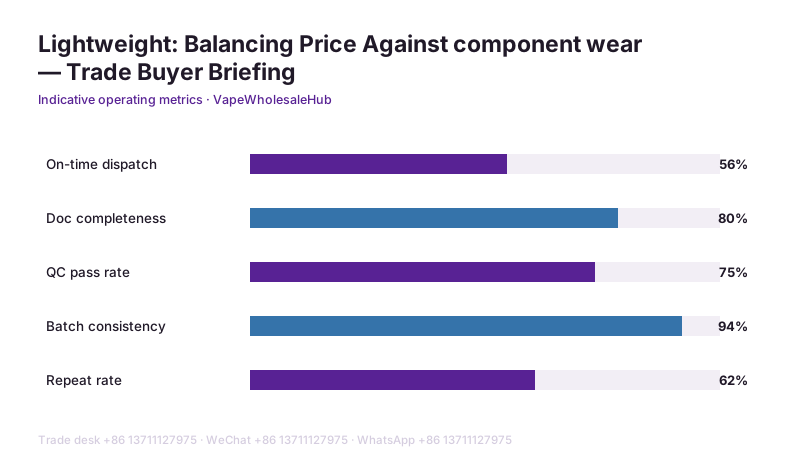
Most conversations about lightweight: Balancing Price Against component wear — Trade Buyer Briefing start in the wrong place. Someone asks for a price per unit before anyone has agreed what the unit actually is. This page works through the subject the way a purchasing desk experiences it, from the first sample request to the container arriving at the dock.
Where the supply actually comes from
A useful test for lightweight: Balancing Price Against component wear — Trade Buyer Briefing is to ask two suppliers the same uncomfortable question and compare how long the answer takes. Serious operations have the data ready. Everyone else needs to check with someone, and that delay tells you how the next twelve months will feel.
On the sourcing side, lightweight: Balancing Price Against component wear — Trade Buyer Briefing comes down to how much of the chain you can see. A trading desk that only ever talks to a sales rep is buying on faith. We prefer accounts that ask for the factory audit, the mixing records and the batch numbers, because that paperwork is what protects everyone when a shipment is questioned later.
What quality control looks like in practice
Quality control on lightweight: Balancing Price Against component wear — Trade Buyer Briefing is unglamorous and repetitive, which is exactly why it works. Incoming inspection, fill weight checks, leak testing and a retained sample from every batch. None of this is clever; all of it is cheaper than a recall.
A quality system for lightweight: Balancing Price Against component wear — Trade Buyer Briefing should produce a number someone is accountable for. Defect rate per batch, days to resolution, repeat complaint rate. Without a number, quality becomes an opinion, and opinions do not survive a busy quarter.
Freight, packaging and landed cost
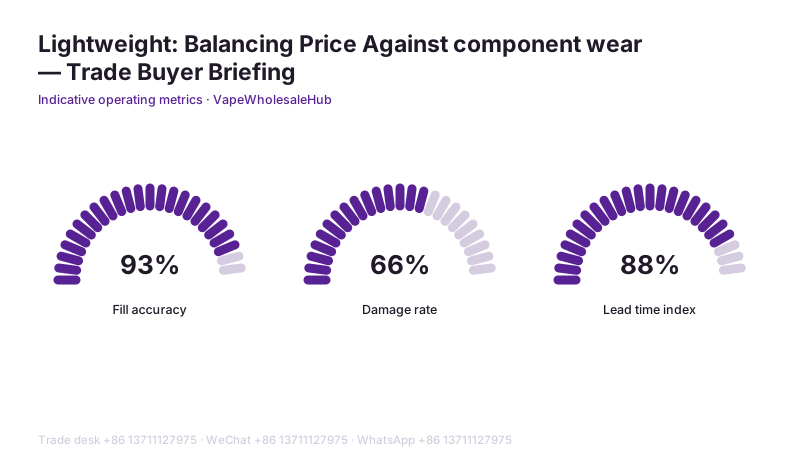
Freight for lightweight: Balancing Price Against component wear — Trade Buyer Briefing has its own rhythm. Peak season rates, holiday closures and carrier capacity all move the landed cost in ways that a unit price sheet never shows. We plan replenishment backwards from the shelf date rather than forwards from the order date, and it removes most of the surprises.
Logistics decides whether lightweight: Balancing Price Against component wear — Trade Buyer Briefing is profitable more often than product quality does. A three day saving on a freight route is worth more per unit than most price negotiations, and it is usually easier to achieve. Mode choice, consolidation and customs pre-clearance are where the margin actually lives.
The commercial side of the decision
Commercially, lightweight: Balancing Price Against component wear — Trade Buyer Briefing rewards buyers who think in turns rather than in unit cost. A slightly higher price on a line that sells through twice as fast is better money than a cheap line that occupies shelf space and working capital for two seasons.
The accounts that grow steadily on lightweight: Balancing Price Against component wear — Trade Buyer Briefing tend to do one boring thing well: they reorder before they run out. It sounds obvious. In practice, most wholesale buyers reorder late, pay for expedited freight, and then blame the supplier for the cost.
Order structure at a glance
| Item | Standard | Volume | Programme |
|---|---|---|---|
| Typical order unit | Master carton | Pallet | Full container |
| Documentation | COA + SDS | COA + SDS + batch record | Full technical file |
| Lead time | 2-4 working days | 5-10 working days | 15-25 working days |
| Customisation | Label only | Label + closure + bottle | Full OEM / ODM |
| Sampling | Charged, credited on order | Included in development | Multi-round approval |
| Indicative MOQ | 500 units | 2,500 units | 10,000 units |
| Development window | n/a | 10-15 working days | 10-15 + approval |
Common questions
Is there a warranty on hardware?
Hardware carries a limited warranty against manufacturing defects, covering dead on arrival and early failure within the stated period. Consumable parts such as coils and pods are excluded, as their life depends on how the end user treats them.
Which payment methods do you accept?
We accept bank wire transfer for most wholesale accounts, with card and digital payment options available for samples and smaller orders. Established accounts can apply for credit terms after a trading history has been established.
Do you offer private label or OEM production?
We do. Private label covers artwork, bottle and closure choice on existing formulations. OEM and ODM work goes further into housing, tooling and exclusive development, with confidentiality agreements in place before any formulation detail is shared.
Related reading
- Lightweight: Balancing Price Against user handling — Export Market Guide
- Lightweight and storage conditions: A Cost Perspective — Cash and Carry Notes
- Lightweight and user handling: Notes From the Trade Desk — Regional Depot Guide
- Lightweight Vape Supply Notes 468
- Lightweight Vape Supply Notes 776
- Lightweight and Display Unit Economics — Regional Depot Guide
Talk to the wholesale desk. Specifications, MOQ, stock and freight options for lightweight: Balancing Price Against component wear — Trade Buyer Briefing.
Phone +86 13711127975 · WeChat +86 13711127975 · WhatsApp +86 13711127975