Lightweight: Evaluating Total Cost of Ownership — Scaling Up
VapeWholesaleHub Lightweight · Lightweight hardware build
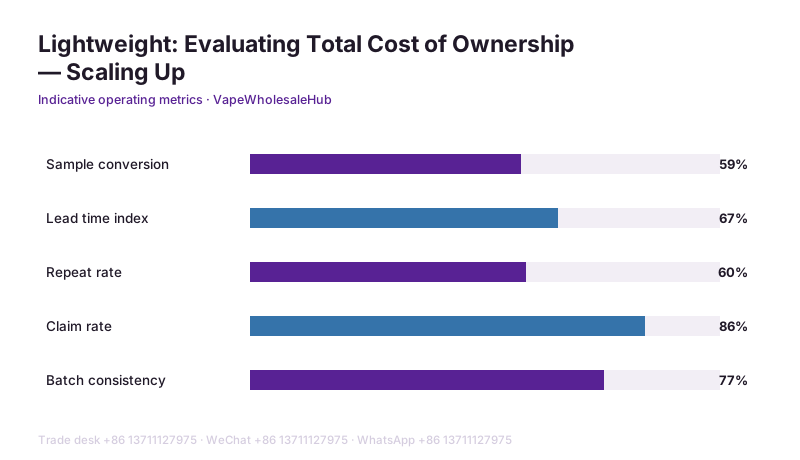
If you buy in volume, lightweight: Evaluating Total Cost of Ownership — Scaling Up stops being a product question and becomes an operations question. Forecasting, documentation, freight windows and after-sales all sit inside the same decision. The notes below are written for people who place the orders and then have to live with them.
Where the supply actually comes from
A useful test for lightweight: Evaluating Total Cost of Ownership — Scaling Up is to ask two suppliers the same uncomfortable question and compare how long the answer takes. Serious operations have the data ready. Everyone else needs to check with someone, and that delay tells you how the next twelve months will feel.
Sourcing decisions around lightweight: Evaluating Total Cost of Ownership — Scaling Up are usually made on price and then regretted on consistency. The input changes, the tolerance drifts, and suddenly the line that sold through in March behaves differently in July. Locking the input specification in writing is the cheapest insurance a wholesale buyer can buy.
Documentation and regulatory reality
Compliance is where lightweight: Evaluating Total Cost of Ownership — Scaling Up either holds together or quietly falls apart. Regulators are not interested in intent; they want documents that match the physical goods. If the label says one thing and the test report says another, the shipment is the problem, not the paperwork.
The compliance burden around lightweight: Evaluating Total Cost of Ownership — Scaling Up is mostly about being boring and consistent. Keep one version of the truth for every SKU, stamp the revision date, and make sure the file a regulator sees is the same one your warehouse picks from. Most enforcement cases we have watched started with a mismatch between two internal documents.
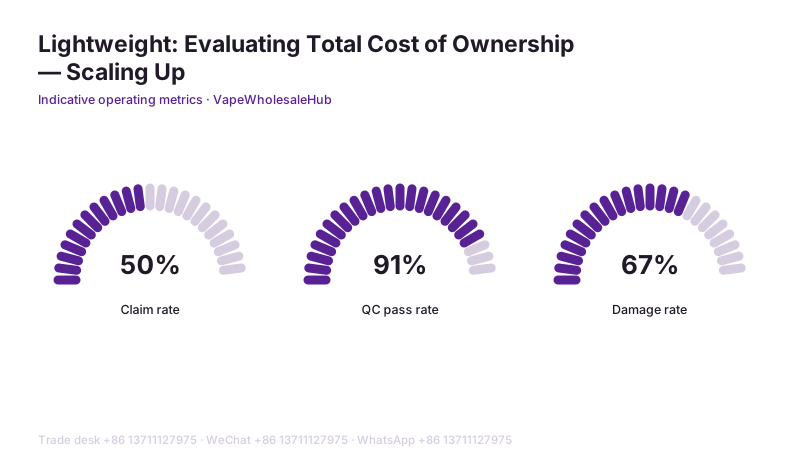
Technical detail worth understanding
Technically, lightweight: Evaluating Total Cost of Ownership — Scaling Up is a set of tolerances rather than a single specification. Coil resistance varies, battery capacity degrades, and perception shifts with device temperature. Designing within those tolerances is what separates a product that works from one that works in the lab.
Specification drift is the quiet risk in lightweight: Evaluating Total Cost of Ownership — Scaling Up. A unit approved in January is not necessarily the unit shipped in September unless the change control is tight. We document every revision, and we tell accounts before the change rather than after someone notices.
Freight, packaging and landed cost
Packaging is part of logistics, not marketing. Cartons for lightweight: Evaluating Total Cost of Ownership — Scaling Up need to survive stacking, humidity and a forklift operator having a bad Monday. We specify board grade and pallet pattern before we talk about print finish, because a damaged pallet costs more than any artwork upgrade recovers.
Freight for lightweight: Evaluating Total Cost of Ownership — Scaling Up has its own rhythm. Peak season rates, holiday closures and carrier capacity all move the landed cost in ways that a unit price sheet never shows. We plan replenishment backwards from the shelf date rather than forwards from the order date, and it removes most of the surprises.
Order structure at a glance
| Item | Standard | Volume | Programme |
|---|---|---|---|
| Typical order unit | Master carton | Pallet | Full container |
| Documentation | COA + SDS | COA + SDS + batch record | Full technical file |
| Lead time | 2-4 working days | 5-10 working days | 15-25 working days |
| Customisation | Label only | Label + closure + bottle | Full OEM / ODM |
| Sampling | Charged, credited on order | Included in development | Multi-round approval |
| Indicative MOQ | 300 units | 1,500 units | 6,000 units |
| Development window | n/a | 7-12 working days | 7-12 + approval |
Common questions
How long does a bulk order take to arrive?
Stock lines usually leave the warehouse within two to four working days, with transit depending on the mode you choose. Custom development runs on a longer clock: formulation, approval, production and testing before anything ships. We give a written schedule at order confirmation and flag slippage the day we see it.
How are samples handled?
Sample packs are charged at cost with the shipping borne by the buyer, and the amount is credited against your first bulk order. That keeps sampling serious and avoids the delays that come with an open-ended free sample programme.
Do you ship internationally?
We ship to most markets where the import of these products is permitted. Some destinations restrict nicotine containing goods entirely, and a few require additional registration before clearance. We will tell you honestly if a route is not workable before you pay.
Related reading
- Lightweight Vape Supply Notes 1658
- Lightweight Vape Supply Notes 1143
- Lightweight and Freight Claims Administration — Trade Buyer Briefing
- Lightweight Vape Supply Notes 208
- Understanding material selection in Lightweight Wholesale — New Account Setup
- Lightweight Vape Supply Notes 117
Talk to the wholesale desk. Specifications, MOQ, stock and freight options for lightweight: Evaluating Total Cost of Ownership — Scaling Up.
Phone +86 13711127975 · WeChat +86 13711127975 · WhatsApp +86 13711127975