Understanding drop testing in Lightweight Wholesale — Export Market Guide
VapeWholesaleHub Lightweight · Lightweight hardware build
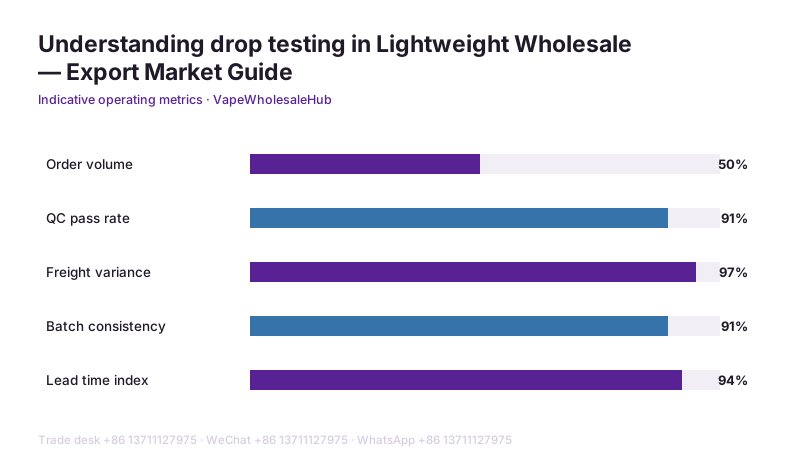
Buyers tend to discover the real cost of understanding drop testing in Lightweight Wholesale — Export Market Guide only after the first full quarter. That is usually when the pattern becomes visible: which lines turn quickly, which ones sit, and which supplier answers the phone. This page sets out the practical checks that make that first quarter cheaper.
What quality control looks like in practice
The failure modes in understanding drop testing in Lightweight Wholesale — Export Market Guide are predictable once you have seen enough of them. Seals that relax in heat, tolerances that drift after a tooling change, inputs that separate in transit. Testing for the known failure modes catches roughly ninety percent of what would otherwise reach a customer.
A quality system for understanding drop testing in Lightweight Wholesale — Export Market Guide should produce a number someone is accountable for. Defect rate per batch, days to resolution, repeat complaint rate. Without a number, quality becomes an opinion, and opinions do not survive a busy quarter.
Freight, packaging and landed cost
Packaging is part of logistics, not marketing. Cartons for understanding drop testing in Lightweight Wholesale — Export Market Guide need to survive stacking, humidity and a forklift operator having a bad Monday. We specify board grade and pallet pattern before we talk about print finish, because a damaged pallet costs more than any artwork upgrade recovers.
Logistics decides whether understanding drop testing in Lightweight Wholesale — Export Market Guide is profitable more often than product quality does. A three day saving on a freight route is worth more per unit than most price negotiations, and it is usually easier to achieve. Mode choice, consolidation and customs pre-clearance are where the margin actually lives.
Technical detail worth understanding
Technically, understanding drop testing in Lightweight Wholesale — Export Market Guide is a set of tolerances rather than a single specification. Coil resistance varies, battery capacity degrades, and perception shifts with device temperature. Designing within those tolerances is what separates a product that works from one that works in the lab.
The engineering around understanding drop testing in Lightweight Wholesale — Export Market Guide is mostly about managing heat and airflow. Change either and the whole experience moves. Buyers who understand that relationship can read a spec sheet properly and spot the marketing numbers that do not survive contact with a customer.
The commercial side of the decision
The accounts that grow steadily on understanding drop testing in Lightweight Wholesale — Export Market Guide tend to do one boring thing well: they reorder before they run out. It sounds obvious. In practice, most wholesale buyers reorder late, pay for expedited freight, and then blame the supplier for the cost.
Margin on understanding drop testing in Lightweight Wholesale — Export Market Guide is usually set by the structure of the deal, not the sticker. Payment terms, freight responsibility, breakage allowance and return rights all move the real number. We would rather agree a clean structure with a fair price than a low price with vague terms that get argued about later.
Order structure at a glance
| Item | Standard | Volume | Programme |
|---|---|---|---|
| Typical order unit | Master carton | Pallet | Full container |
| Documentation | COA + SDS | COA + SDS + batch record | Full technical file |
| Lead time | 2-4 working days | 5-10 working days | 15-25 working days |
| Customisation | Label only | Label + closure + bottle | Full OEM / ODM |
| Sampling | Charged, credited on order | Included in development | Multi-round approval |
| Indicative MOQ | 300 units | 1,500 units | 6,000 units |
| Development window | n/a | 10-15 working days | 10-15 + approval |
Common questions
How long does a bulk order take to arrive?
Stock lines usually leave the warehouse within two to four working days, with transit depending on the mode you choose. Custom development runs on a longer clock: formulation, approval, production and testing before anything ships. We give a written schedule at order confirmation and flag slippage the day we see it.
What shelf life should we plan around?
Unopened e-liquid is typically stable for around two years when stored cool and away from direct light, and device batteries lose capacity on a similar curve. We print manufacture dates and batch codes on every unit so stock rotation is straightforward.
Can you supply documentation for our regulator?
Yes. Technical files, certificates of analysis, safety data sheets and batch records are provided with shipments on request. Tell us which national scheme you operate under at the enquiry stage and we will confirm exactly which documents come as standard.
Related reading
- Lightweight Vape Supply Notes 1046
- Lightweight and seal integrity: A Cost Perspective — Independent Shop Notes
- Managing seal integrity Across Lightweight Product Lines — High Volume Planning
- Lightweight Vape Supply Notes 52
- Understanding user handling in Lightweight Wholesale — Online Reseller Notes
- Lightweight Vape Supply Notes 1397
Talk to the wholesale desk. Specifications, MOQ, stock and freight options for understanding drop testing in Lightweight Wholesale — Export Market Guide.
Phone +86 13711127975 · WeChat +86 13711127975 · WhatsApp +86 13711127975